The Garden and the Bridge
On 19 October 2026, MIT Technology Review reported on an essay by Goodfire researcher Nick Cammarata. His essay challenged a line researchers have repeated for years: that modern AI is “grown like a garden, not built like a bridge.”
Think about the language you spoke this morning. Who invented it? Nobody remembers who invented the word for water, not in Hindi, not in Tamil, not in any language. There was no meeting, no announcement, no first speaker we could name. And yet millions of us understand each other every day without a second thought.
Nobody invented Hindi. Nobody invented Tamil. While scholars later designed written scripts and official grammar rules, no committee or named individual invented the spoken mother tongues.
That puzzle feels like a question about something else. Artificial intelligence: was it built, or did it grow? And whose words did it grow from?
Spoken first
Which came first, speaking or writing? Speaking, by a very long distance. People talked for tens of thousands of years before anyone pressed a mark into clay. The oldest writing we know, from Mesopotamia, is only about 5,000 years old.
Many languages today are spoken and have never been written down. Of the roughly 7,000 living languages, close to 3,000 probably have no developed writing system at all.
Understood, or it is not a language
A sound is only a sound until another person understands it. A mark on a stone is only a mark until someone can read it. A language begins at the moment it is understood.
A small child shows this every day. Nobody hands a toddler a dictionary. The child listens, tries, gets it wrong, and tries again. Meaning is built by sharing.
Nicaragua offers a rarer example. In 1977, a special education primary school in Managua opened with 25 deaf students. It expanded to 100 students in 1979, and served more than 400 by 1983. They arrived with no common language, only simple gestures from their own homes. Teachers tried to teach them lip-reading, spoken and written Spanish, and finger-spelling. Those lessons failed.
Nobody taught them a sign language. On the school buses and playground, the first group combined gestures into a rough shared system. Over the years they built one among themselves, and each new group of children aged 10 and younger made it richer, creating spatial rules. Linguists have studied it ever since as Nicaraguan Sign Language (ISN).
Scholars still debate this. Some argue the children’s minds drew on an inborn grammar blueprint. Others argue the structure grew from general human pattern-finding and social interaction. A pattern is simply a regular arrangement that repeats. Regardless of the debate, nobody designed it. The children needed to understand one another, so they made it.
Now the AI: built, grown, or gathered?
Put the same question to AI.
The ability behind it was already in us: noticing patterns, learning from experience, reasoning. In us, these abilities are living experience. The machine, though, was built, and it only multiplies tables of numbers.
The comparison with a child breaks down quickly. A human child learns to speak from 10 million to 100 million words heard in a real room with caring adults. A large language model is trained on trillions of word fragments scraped in bulk, then adjusted by paid human reviewers.
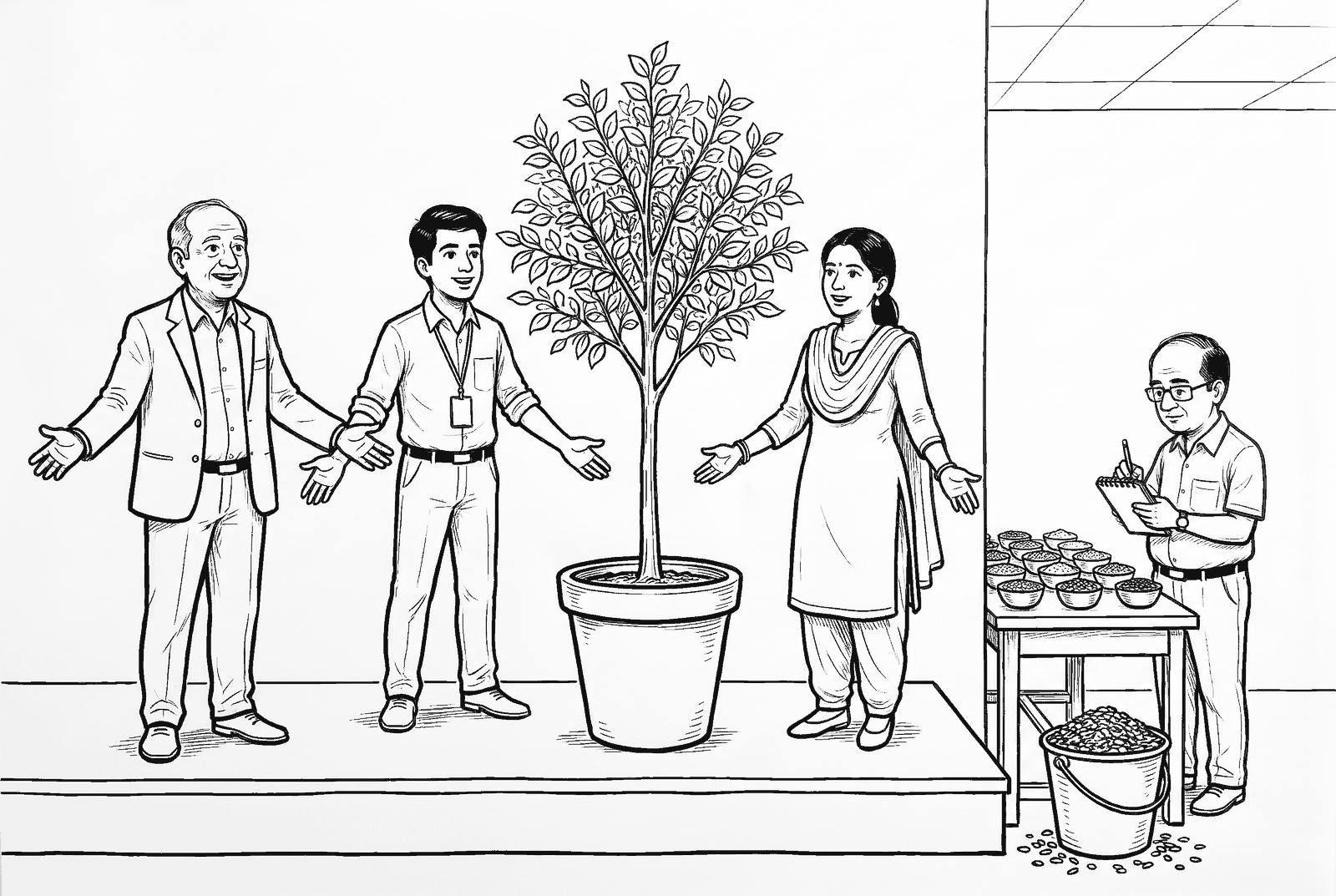
In April 2025, Anthropic chief executive Dario Amodei wrote that modern generative AI systems are “grown more than they are built.” Engineers choose the framework, data, and training rules the way a gardener chooses soil, water, and seeds. But the inside is billions of numbers that self-organise into an unreadable tangle. Jacob Hilton at the Alignment Research Center estimates researchers understand less than 0.01 per cent of how today’s largest models work inside.
Cammarata’s essay argued the opposite: “We’ve been looking at it wrong.” In an old Google image model, one part seemed to mix up cats and cars. Looked at again, it was not confused. It was spotting one simple shape, a V, that appears in both. In a much newer model, he estimates about 9 in 10 parts each do one main job. If he is right, the inside of these machines is far tidier than we thought.
Not everyone agreed. Stanford professor Chris Potts called the essay a hunch that makes no real work easier. Neel Nanda at Google DeepMind said single parts are only one piece of a much bigger puzzle.
A year earlier, software architect Brendan Dixon had pointed out where the garden picture itself breaks. A model, he wrote, is “gathered, not grown.” It has no life or desires. It chops human writing into small pieces of three or four letters, called tokens (a word like “therapist” may become “thera” and “pist”), and gathers numbers on how those pieces relate to one another.
Already among us
When your phone completes your sentence, when a map finds a quicker road, when your bank stops a suspicious payment, an AI system is at work. But these are small programs, each built for one narrow job. Google’s Gboard keyboard runs a model of about 1.4 million adjustable numbers on the phone itself, and suggests your next word in under 20 milliseconds. Google Maps pairs its older route planner with a newer network that reads roads in segments, and Google says this cut arrival-time errors by up to half in some cities. A card tap has to be approved in about a fifth of a second, so banks use quick chains of yes-or-no checks, called decision trees, that score each payment for fraud in 1 to 5 milliseconds. Most of us began using these tools long before we thought to ask what they were.
The test is the same
Language matters so much for India because of one question: whose words were actually gathered? In a study published on 25 June 2026, researchers Mayuree Pal and C. P. Rashmi audited the web archives behind large models. At least 64 per cent of 47 major text-generating models rely on filtered copies of Common Crawl, a free public archive of billions of web pages collected by a non-profit. In Meta’s LLaMA-1 model, 82 per cent of the training text comes from two English datasets, where an automated filter actively deleted non-English web pages.
English accounts for 49.3 per cent of the top 10 million websites, even though only 25.9 per cent of internet users speak English as a first language. Meanwhile, Hindi in Devanagari script accounts for less than 0.1 per cent of website content. Nearly all of the world’s other 7,000 languages, including Tamil, Marathi, Malayalam, and Assamese, sit below 0.1 per cent each.
A farmer in Vidarbha, a student in Kerala, a shopkeeper in Assam should be able to ask a question in their mother tongue, the first language a child grows up speaking at home, and get an answer they can use. When technology learns to speak to us, instead of expecting us to learn its language, that is when it truly arrives.
I learnt how much one word can carry when I recently shifted to Delhi from Kerala. I walked confidently up to a vendor in Sarojini Nagar, pointed at a leather jacket, and asked, “Bhaiya, iska vella kya hai?” His face hardened at once. I thought I was asking the price in perfect, Malayalam-tinted Hindi. I had actually called him jobless. “Hum toh kaam kar rahe hain, tum bade velle ho!” he snapped back. We are the ones working here, you are the idle one. I paid double just to escape the awkwardness.
Velle is Delhi street speech. It belongs to the street, not to the textbook. That is the gap between a bhasha and a boli. A bhasha is a standard language, with a script, a grammar and a place in schools and offices. A boli is the everyday speech of a district or a village, mostly spoken, and it shifts as you travel: kos-kos par badle paani, chaar kos par baani (the water changes every kos, the speech every four). The 2011 Census recorded 19,569 names for mother tongues and sorted them into 121 languages. Bhojpuri, spoken by more than 50 million people, is counted under Hindi. A language model learns mostly from written text, and written Hindi is mostly standard Hindi. The farmer in Vidarbha may well speak Varhadi, a dialect of Marathi. Reading a bhasha is not the same as understanding a boli, and these models will need far more training on how India speaks, not only on how it writes.
What I believe, and cannot prove
Here I stop reporting. What follows is my belief, not evidence.
Calling a large language model “grown like a garden” lets its builders off the hook too easily. A wild plant grows without anyone choosing its leaves. Every large language model reflects human choices: which web pages the filter kept, which languages were left under 0.1 per cent, and which answers paid reviewers rewarded. For a reader in India, the biggest barrier to understanding AI is not the mathematical tangle inside the networks. It is that the machine was trained overwhelmingly in someone else’s language.
My weak point is that I am leaning on open academic audits of earlier datasets like LLaMA-1 and top-website counts, because commercial companies rarely publish the exact language breakdown of their newest 2026 models.
The harder objection comes from researchers like Chris Olah, Dario Amodei, and Jacob Hilton: even if a model was trained 100 per cent on Hindi, Tamil, Marathi, Malayalam, and Assamese, nobody would understand more than a tiny fraction of the billions of number weights inside it. Speaking your mother tongue fluently on the outside does not make a black box readable on the inside. In fact, a machine that answers smoothly in your own mother tongue might be even easier to trust when it is wrong.
What you can do on Tuesday
Try an informal reader test. Take one everyday factual question about your own town or work. Ask a free large language model first in English, and then ask the exact same question in your mother tongue. Check two things: does the mother-tongue reply give as many specific, checkable details as the English reply, and does the phrasing sound like a neighbour speaking or like an English sentence translated word by word?
Next time you see a headline saying AI “learned like a human” or “grew,” ask three questions:
- Which exact program is it? A tiny phone keyboard that guesses your next word, a bank’s split-second fraud check, or a chatbot trained on trillions of word pieces?
- Whose words was it trained on, and what did the filter throw out?
- Who is using the word “grown”, and why? Are they explaining that engineers did not hand-code every rule, or claiming nobody is responsible for what the machine does?
So was AI built, or did it grow? Language lived in our nature and took shape because we needed each other to understand. AI was built by us, from our own words and knowledge, and it will be at its best when everyone can understand it.
A bridge has blueprints. A garden has soil, water, and a gardener who chose the seeds. Technology, like language, belongs to everyone only when everyone can understand it.
November 10, 2026 | arun.mp15@yahoo.com
Sources
Will Douglas Heaven, “‘We were looking at it wrong’: The explosive claim that’s upended the AI world”, MIT Technology Review, 19 October 2026.
Nick Cammarata, Curt Tigges and Tarun Gogineni, “Neural Networks Are Already Clean”, Goodfire, October 2026.
Dario Amodei, “The Urgency of Interpretability”, 24 April 2025.
Brendan Dixon, “Fearing the Terminator: Does Current Tech Warrant the Doomsaying?”, Mind Matters, 22 October 2025.
John McCarthy, Marvin Minsky, Nathaniel Rochester and Claude Shannon, “A Proposal for the Dartmouth Summer Research Project on Artificial Intelligence”, 31 August 1955.
Alan M. Turing, “Computing Machinery and Intelligence”, Mind, October 1950.
Ann Senghas and Marie Coppola, “Children Creating Language”, Psychological Science, July 2001.
Judy Shepard-Kegl, Nicaraguan Sign Language Manual, 3rd Edition, 2018.
Proto-cuneiform chronology and discovery, Wikipedia, accessed 9 November 2026.
Ethnologue, “How many languages in the world are unwritten?”, 25th edition, accessed 10 November 2026.
Mayuree Pal and C. P. Rashmi, “Epistemological Asymmetries in the Digital Archive”, Digital Humanities and Society Studies, 25 June 2026.
Office of the Registrar General and Census Commissioner, India, “Census of India 2011: Language, India, States and Union Territories”, Table C-16, June 2018.
Shuying Liu, Zhe Zhang and Jia Gu, “Distill-and-Reinforce”, Lund University, 2026.
Oliver Lange and Luis Perez, “Traffic prediction with advanced Graph Neural Networks”, Google DeepMind, 3 September 2020.
Alex Kugell, “Why Your Fraud Model Needs to Decide in 45 Milliseconds”, Ledger Drift, 3 November 2026.
Andrew Hard et al., “Federated Learning for Mobile Keyboard Prediction”, November 2018.
Was this worth your time?