The Sage and the Scanner
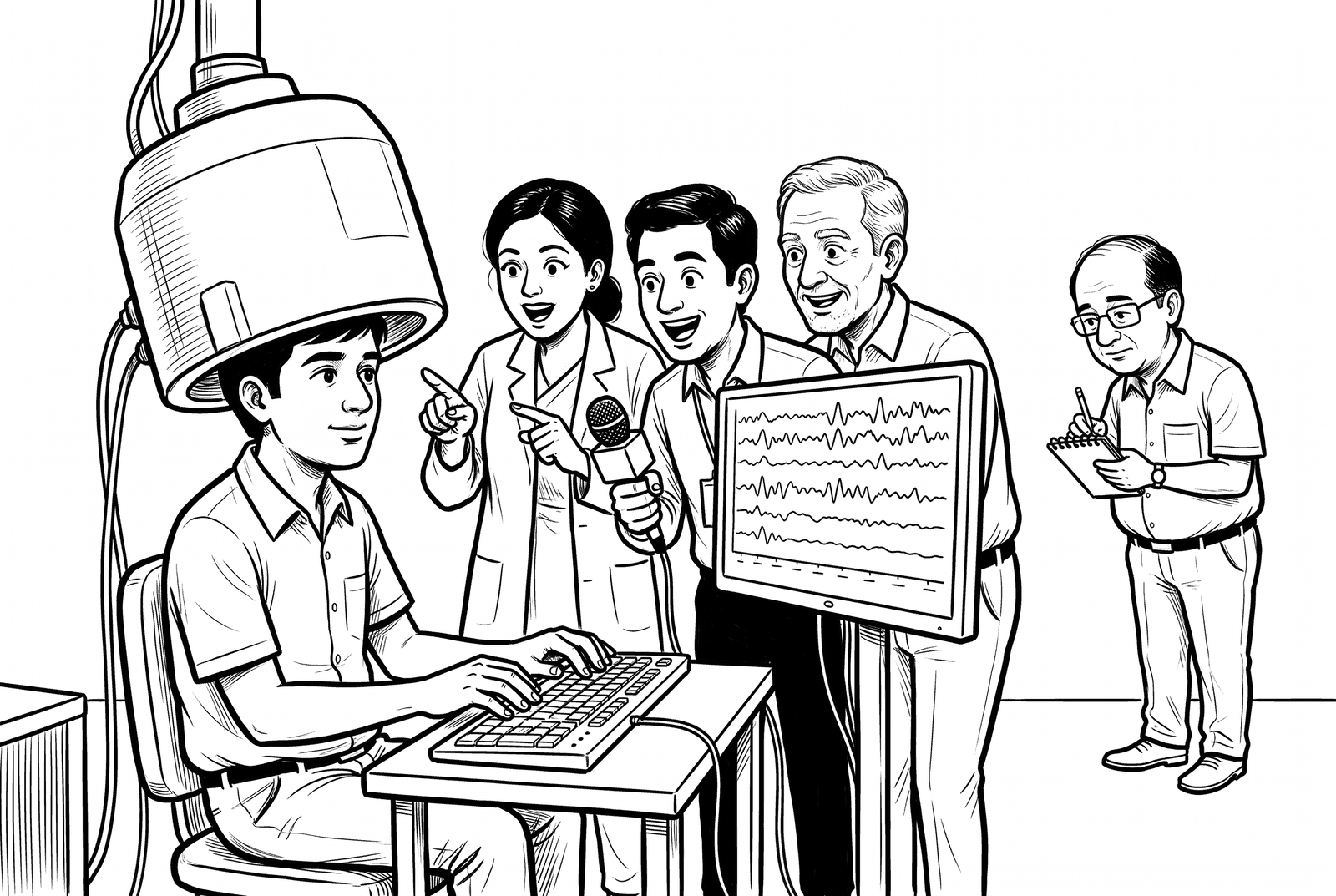
On 29 June 2026, Meta published research on reading sentences from the brain without surgery. Nine volunteers each spent ten hours inside a brain scanner called MEG. A computer model read their brain signals and got 61 per cent of the words right. Here is the part most headlines left out. Every volunteer was typing on a keyboard while the scanner listened.
So the machine did not read a thought. It read the orders the brain sent to the fingers. That is still remarkable. But it is a long way from mind reading, and that gap is what this post is about.
Patterns all the way down
We already live with machines that find patterns we cannot see. Given enough examples, a model can predict the next word or the next fault in a turbine. It does not understand any of it. It picks the most probable outcome, and it is right often enough to be useful.
Even the name is borrowed. In 1943, Warren McCulloch and Walter Pitts described an “artificial neuron”, a rough sketch of a nerve cell. Today’s neural networks keep the name and little else. Scientists can tell you which part of the brain becomes active when you move a finger or hear a word, but nobody can yet explain how those cells give you the simple feeling of knowing what you are about to say before you say it.
Now that borrowed idea is being turned back on the brain itself. No wonder Neuralink and Brain2Qwerty catch the public eye so quickly.
What the machine actually did
Brain2Qwerty first appeared in February 2025. A reviewed version was published in June 2026 in Nature Neuroscience. It tested 35 healthy volunteers, all good typists, typing sentences from memory.
The results depended on the sensor. With the MEG scanner, the machine got about 29 per cent of the letters wrong on average. With EEG, the cheaper cap you may have seen in a hospital, it got 65 per cent wrong. The authors admit that patients who cannot move at all would need a version that works from imagined movement. That version does not exist yet.
The second version, with the nine volunteers from the top of this post, came out the same day. It runs live. On average it gets 39 per cent of words wrong. It still needs typing, and it still needs MEG.
An MEG scanner is not a headband. It sits inside a specially shielded room, and the volunteer must sit still and cooperate for hours, so nobody will be wearing one on the Delhi Metro any time soon.
Errors in letters and errors in words are different measures.
What the sages were said to do
Many of us grew up on stories of rishis who knew a visitor’s question before it was asked. Patanjali’s Yoga Sutra III.19 reads pratyayasya para-citta-jñānam: knowing another’s mind by observing its impressions. For most of us, such stories sat somewhere between scripture, fable and miracle.
Scientists have tested telepathy for nearly a century. The results are disputed, and mainstream science does not accept that it exists.
The machine version has been shown, and it began in Kerala. In 2014, a team led by Carles Grau and Giulio Ruffini sent the word “hola” from a volunteer in Thiruvananthapuram to a receiver in Strasbourg, France, 7,800 kilometres away. The sender imagined moving his hands for a 1 and his feet for a 0. An EEG cap picked this up. In France, magnetic pulses made the blindfolded receiver see flashes of light. It took 140 bits, a team of engineers, a robot and two fully cooperating volunteers to send one short greeting that WhatsApp delivers in under a second.
The rishi needed none of that. That is the honest measure of where we stand.
The room with no window
Suppose these machines become small, cheap and accurate. What happens to the one room no one else can enter?
The case for welcoming them is real. People who cannot speak would be heard. A doctor would know what a stroke patient wants. Some argue that many human quarrels come from misunderstanding, and that more open minds would lie less and hurt each other less.
The case against rests on what thought is for. The mind is where we rehearse, doubt, rage and change our minds before anyone sees. A thought you know may be read is no longer free. Scholars such as Nita Farahany argue that mental privacy should be a human right.
India has already faced this question in court. In 2010, in Selvi v. State of Karnataka, the Supreme Court ruled that forcing brain-mapping and similar tests on an accused person violates the constitutional right not to be a witness against oneself.
For now, the strongest protection is physics. A 2023 decoder from the University of Texas needed up to 15 hours of a volunteer lying still in an MRI scanner. Volunteers defeated it by thinking about animals. The law is moving slowly: UNESCO adopted guidelines on the ethics of neurotechnology in November 2025 that treat brain data as especially sensitive, but they bind no country, and India’s Digital Personal Data Protection Act of 2023 does not mention brain data at all.
Where the case is strongest
For people who have lost their speech, the argument is easiest to make. In August 2024, the New England Journal of Medicine reported on Casey Harrell, a 45-year-old American with ALS, a disease that destroys the nerves controlling the muscles. Electrodes placed in his brain let him put the words he intended on a screen with up to 97.5 per cent accuracy.
Even here, the record is mixed. More than 350 blind people received the Argus II retinal implant. Its maker later stopped supporting it, leaving patients with outdated hardware in their eyes. Brain surgery carries risk, and an implant needs a company that outlasts the patient’s need for it. Medicine is the best case for this technology, but not a free one.
The apple on the table
My mother was a teacher all her life. In her late seventies, she had a mini-stroke. Her movement and her thinking came back, slowly. Some ordinary words did not. The name of a fruit or a vegetable would slip away. She would point at the apple on the table and say, “Give me that.” The word “apple” would not come to her, though it comes to the rest of us without effort.
When I read about Brain2Qwerty, I thought of her. A machine that turns brain signals into words seemed exactly what she needed. Then I read what it decodes: the orders sent to the fingers after a person already has the word. My mother’s difficulty came one step earlier. She knew what she wanted, but the word itself would not arrive, and I do not know whether any decoder, today or in ten years, can reach into that gap between knowing and naming. I would like the answer to be yes, for her and for others like her. Wanting it is not the same as knowing it.
What to do on Tuesday
Next time a headline says AI can read minds, ask three questions. What was the person doing while the machine listened? How big was the machine? How many errors did it make, and how were they counted? For Brain2Qwerty, the answers are typing, room-sized, and 39 per cent of words wrong on average.
I cannot tell you whether this is good, bad or ugly. Probably all three, for different people. The sage was said to read minds with nothing but attention. The scanner reads keystrokes with a shielded room and ten hours of cooperation. The future lies somewhere between the two. What we will need is still unwritten.
October 6, 2026 | dasgupta.basab@gmail.com
Sources
Zhang, M., Levy, J., Rommel, C. et al. (2026). Accurate Decoding of Natural Sentences from Non-Invasive Brain Recordings. Meta AI, 29 June 2026. ai.meta.com/research/publications/accurate-decoding-of-natural-sentences-from-non-invasive-brain-recordings/
Lévy, J., Zhang, M., Pinet, S. et al. (2026). Noninvasive decoding of typed sentences from human brain activity. Nature Neuroscience. doi.org/10.1038/s41593-026-02303-2
Meta AI (2026). From Brain Waves to Words: Brain2Qwerty Offers a New Path to Communication Without Surgery. ai.meta.com/blog/brain2qwerty-brain-ai-human-communication/
McCulloch, W. S. and Pitts, W. (1943). A logical calculus of the ideas immanent in nervous activity. Bulletin of Mathematical Biophysics, 5, 115 to 133.
Grau, C., Ginhoux, R., Riera, A. et al. (2014). Conscious brain-to-brain communication in humans using non-invasive technologies. PLOS ONE, 9(8), e105225.
Storm, L., Tressoldi, P. E. and Di Risio, L. (2010). Meta-analysis of free-response studies, 1992 to 2008. Psychological Bulletin, 136(4). Hyman, R. (2010). Meta-analysis that conceals more than it reveals. Same issue.
Farahany, N. A. (2023). The Battle for Your Brain. St. Martin’s Press.
Selvi and Others v. State of Karnataka, (2010) 7 SCC 263, Supreme Court of India.
Tang, J., LeBel, A., Jain, S. and Huth, A. G. (2023). Semantic reconstruction of continuous language from non-invasive brain recordings. Nature Neuroscience, 26, 858 to 866.
UNESCO (2025). Recommendation on the Ethics of Neurotechnology. Adopted 12 November 2025.
Card, N. S. et al. (2024). An accurate and rapidly calibrating speech neuroprosthesis. New England Journal of Medicine, 391, 609 to 618.
Strickland, E. and Harris, M. (2022). Their bionic eyes are now obsolete and unsupported. IEEE Spectrum, February 2022.
Was this worth your time?