You Are Not the Customer
You looked at a pair of shoes on Tuesday. One pair, on one website, for about forty seconds.
By Thursday the shoes are following you. They are on Instagram between two holiday photographs. They are down the side of a news site you have never visited before. They are in your Facebook feed on Saturday morning, maybe the same shoes, still waiting for you to buy.
Most of us have a ready explanation for this. If the product is free, you are the product.
Two writers have spent entire books arguing that this line is far too kind to us. They agree on one thing. You are not the customer. They disagree, completely and importantly, about what you are instead.
That disagreement is not a quarrel between academics. It decides whether India’s new data protection rules are the answer or a distraction.
How the shoes found you
Start with how it works, because it is not what most people assume.
Instagram is owned by Meta. So are Facebook and WhatsApp. Whatever you do on one of them, the same company is holding the pen.
Nobody there was watching you look at shoes. The shoe shop told them.
Almost every commercial website carries a small piece of code that the advertising company hands out free. When you open the page, that code sends a short message back. Someone was here. This is what they looked at.
The shop is not the victim in this story. The shop installed the code, and pays to reach you afterwards.
So a business you have no real relationship with passed a note about you to a company you do have a relationship with. Neither of them stopped to ask you at the time.
You did agree once, years ago, in a document you did not read, on the day you opened the account. You have been agreeing every day since without being asked again.
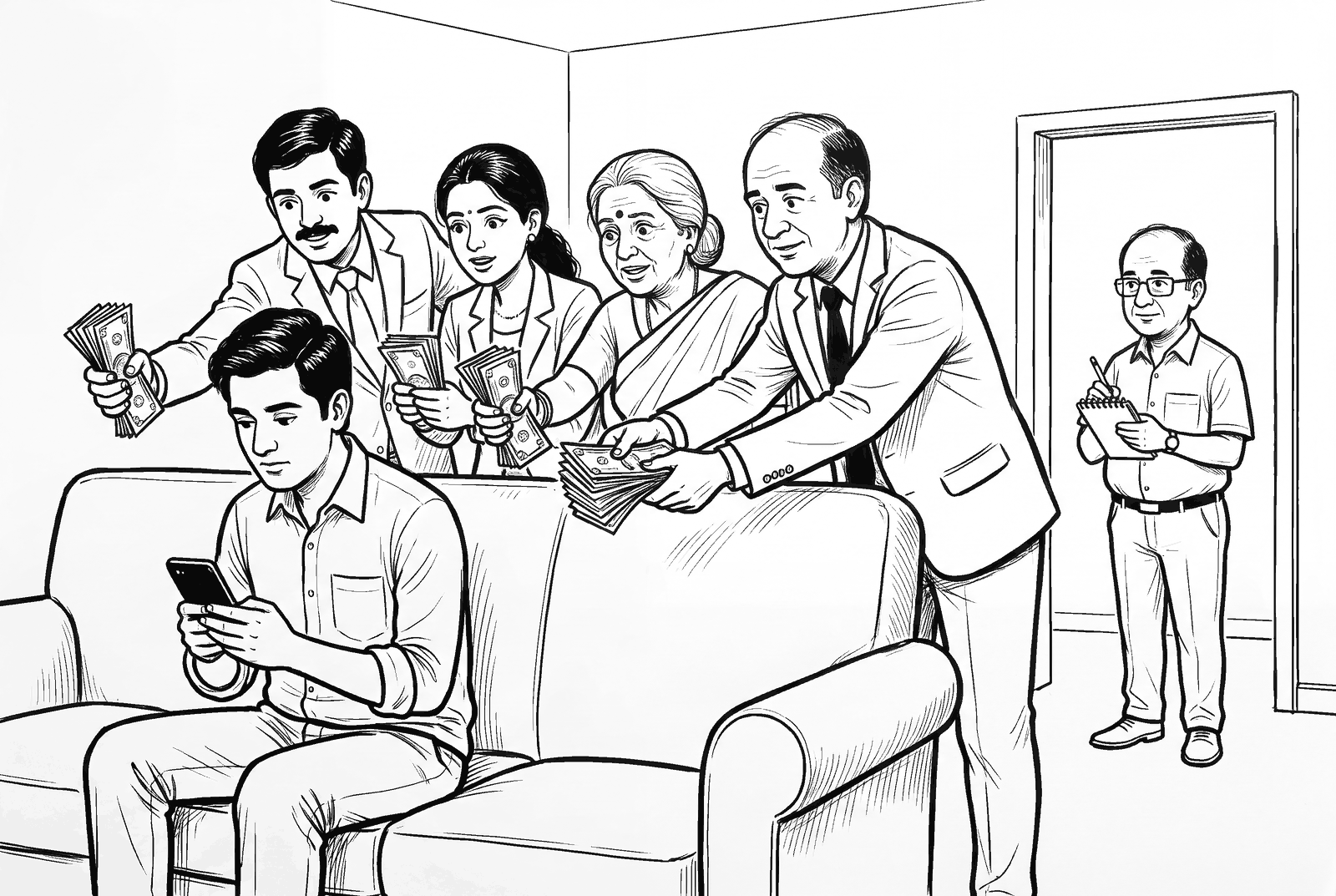
Surveillance capitalism: you are the raw material
Shoshana Zuboff, an emeritus professor at Harvard Business School, set out her argument in a 2015 paper and a 2019 book.
She gave the arrangement a name that stuck. Surveillance capitalism.
You are not the product. You are the free raw material.
The service you asked for is delivered, and there is data left over. Not the search itself but the way you typed it, how long you paused, what you did next, where you were standing. She calls that leftover behavioural surplus. It is taken because it is there, and because taking it costs nothing.
The surplus is then manufactured into something that does get sold. A prediction about what you will do next. Her term for that marketplace is behavioural futures markets. You are not in it. You are what is being bet on.
So the product is not you. The product is a guess about you, and you will never meet the buyer.
Technofeudalism: you are unpaid staff
Yanis Varoufakis, the economist and former Greek finance minister, published his account in 2023 and it goes considerably further.
His name for what has taken the place of capitalism is technofeudalism.
He argues that the shoes are not an advertising story at all. They are a story about who owns what.
Every review you write, every rating you leave, every photograph you post, every route you drive with the map open, adds value to an asset you do not own and will never own a share of. He calls that asset cloud capital. He calls us cloud serfs, because a serf works land that belongs to somebody else and hands over the produce.
The shopkeeper is in this story too. A seller paying commission on every sale, or an app developer paying a cut of every payment, is not really a competitor in a market. In his account they are cloud vassals, paying rent for permission to reach you at all.
Rent, not profit. That distinction carries his whole argument. Profit comes from producing something and selling it in a market. Rent comes from controlling the ground everyone else has to stand on.
Where they part company, and why India should care
Zuboff thinks this is capitalism gone wrong. A rogue mutation, a market failure, something that laws and regulators can correct because the underlying machinery is still a market.
Varoufakis thinks capitalism is already dead and that something older replaced it. On his reading you cannot fix this with competition law, because there is no market left to restore. Regulating a landlord as though he were a shopkeeper misses what he actually is.
India notified the Digital Personal Data Protection Rules on 13 November 2025. Compliance is phased across eighteen months. Consent managers register from around November 2026 and the main obligations on companies land around May 2027. Every organisation holding your data will owe you notice, correction, erasure and a ninety day answer.
Read that through Zuboff and it is the fix arriving. Read it through Varoufakis and it is careful regulation of a relationship that stopped being a transaction some years ago.
I do not know which of them is right, and neither does anybody else yet. Evgeny Morozov has argued that the feudalism comparison is a category error, and that digital rent is ordinary capitalism wearing a costume. That objection is worth reading before you accept the more dramatic story, which is the more enjoyable one and therefore the more dangerous one.
The company you have never used
There is a third possibility that neither book quite covers, and it is growing faster than either.
Palantir builds software that lets governments and large organisations pull scattered records into one view. Its revenue for 2025 was 4.48 billion dollars, up 56% on the year before. In a single quarter of 2026 it reported 1.94 billion dollars, up 93% year on year, of which 809 million came from the United States government alone. Those figures are in its own filings with the American securities regulator.
You do not have an account with Palantir. You have never opened its app, agreed to its terms or seen its logo on a screen. There is no setting you can change and no consent you can withdraw, because you were never asked for one.
And note what Palantir is not. Its customers pay it, properly and directly, the way customers have always paid software companies. That is an awkward fact for the feudalism story and I include it because it is awkward.
Not the customer. Not the product. In this case, not even a user.
What you can do about it on Tuesday
On Instagram this takes about thirty seconds. Open the app and tap your profile picture. Tap the three lines in the top right, then Settings and privacy. Accounts Centre sits at the top. Inside it, under Account settings, tap Ad preferences, and then Audience-based advertising.
That last screen lists the advertisers who have put you into an audience using information about you gathered outside Meta. Not what you liked on Instagram. What you did elsewhere, and someone told them.
Meta renames these menus often and rolls the settings out country by country, so if that path does not match your phone, look instead for Ad settings and then Activity information from ad partners. Facebook takes you to the same place, because both apps now share one Accounts Centre.
Do not change anything. Just read the list.
You will not recognise most of the names. Some will be shops you visited once. Some will be companies you have never heard of and have certainly never dealt with. Count them, and write the number down.
That number is the only measurement in this piece that is about you specifically. Everything else here is somebody’s theory, including the parts I find persuasive.
The shoes were never the point. The shoes were the receipt.
September 8, 2026 | dasgupta.basab@gmail.com
Sources: Shoshana Zuboff, “Big Other: Surveillance Capitalism and the Prospects of an Information Civilization”, Journal of Information Technology, 2015, and The Age of Surveillance Capitalism, 2019. Yanis Varoufakis, Technofeudalism: What Killed Capitalism, 2023. Evgeny Morozov, “Critique of Techno-Feudal Reason”, New Left Review, 2022. Ministry of Electronics and Information Technology, Digital Personal Data Protection Rules 2025, notified 13 November 2025. Palantir Technologies, Form 8-K filings, United States Securities and Exchange Commission, 2026.
Was this worth your time?